Jurisdictions
Most founders learn what a jurisdiction is the hard way. A tax bill arrives from a country they didn’t realise they were operating in, and suddenly the question matters a great deal.
Here’s the short version: a tax jurisdiction is any geographic or political area with the authority to levy taxes. A country. A state. Sometimes a city. The moment your startup sells into one, employs someone in one, or routes revenue through one, that jurisdiction may have a claim on your income. With remote teams, SaaS products crossing borders invisibly, and capital moving between continents in seconds, the number of tax jurisdictions your business touches is probably higher than you think.
Understanding how tax jurisdictions work isn’t bureaucratic box-ticking. It’s the foundation of any serious international tax strategy, and getting it wrong is expensive in ways that compound over time.
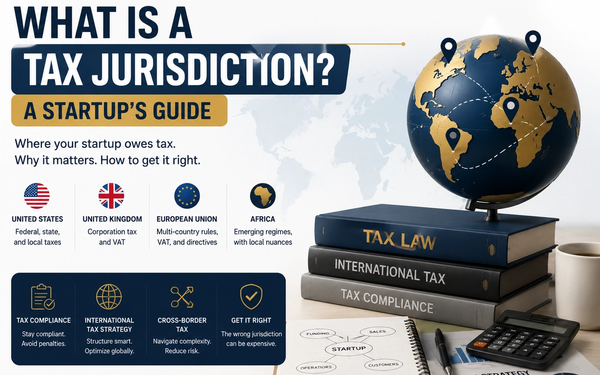
Every jurisdiction has its own rules about who owes tax, on what income, and at what rate. The US taxes its citizens on worldwide income regardless of where they live, which catches many American founders who’ve set up offshore structures without realising the IRS still wants a cut. The UK uses a residence-and-domicile framework that can be surprisingly generous to non-doms, but only if it’s structured correctly from the start. EU member states each have their own corporate tax rates, though they share a common VAT framework that creates its own cross-border tax obligations for digital businesses.
And then there’s Africa. A continent of 54 countries, each a separate jurisdiction, with wildly different tax treaties, withholding tax rates, and exchange control regimes. A startup selling software into Nigeria, Kenya, and South Africa simultaneously is dealing with three entirely different tax frameworks. Most don’t find that out until they’re already entangled.
This matters because of a concept called nexus: the threshold at which a business’s connection to a place becomes significant enough to create a tax obligation. In the US, economic nexus rules introduced after the 2018 South Dakota v. Wayfair Supreme Court ruling mean that crossing a sales threshold in a state (typically $100,000 in revenue or 200 transactions) triggers sales tax obligations there, even with zero physical presence. Multiply that across all 50 states and you can see the problem.
Jurisdictions claim taxing rights in three main ways, and understanding the distinction matters enormously for cross-border tax planning.
The first is residence-based taxation. If your company is incorporated or managed and controlled in a jurisdiction, that jurisdiction generally taxes your worldwide profits. The UK taxes companies that are UK-resident, which is determined not just by incorporation but by where the board actually makes decisions. I’ve seen startups incorporated in Gibraltar or the BVI that were in practice managed from a London kitchen table. HMRC considers those UK-resident companies, and that’s the end of the argument.
The second is source-based taxation. Even if you’re not resident in a jurisdiction, you may owe tax there on income that originates there: royalties, dividends, or fees paid by local businesses to you. This is typically collected through withholding tax, and rates vary dramatically by country and by the tax treaty (if any) between your jurisdiction and theirs.
The third is the increasingly common digital services tax. France, Kenya, Zimbabwe, and several other countries now levy taxes specifically on revenues earned by digital businesses in their markets, regardless of where those businesses are incorporated or resident. These aren’t going away. If anything, they’re spreading as countries grow tired of watching tech revenues flow elsewhere.
A SaaS founder I worked with had built a genuinely impressive product: project management software with customers across the UK, Germany, South Africa, and the US. She’d incorporated in Ireland, sensibly enough, attracted by the 12.5% corporate tax rate and the EU’s IP box regime. But she’d never considered what happened below the holding company level.
Her South African customers were paying licence fees to the Irish entity. South Africa imposes a 15% withholding tax on royalties paid to non-residents, reduced to 10% under the Ireland-South Africa tax treaty, but only if the Irish company could demonstrate genuine substance in Ireland. It couldn’t. The founder worked from Cape Town. Her German customers were triggering VAT obligations she hadn’t registered for. And her US customers in California, Texas, and New York had collectively pushed her past the economic nexus threshold in all three states.
None of these were catastrophic individually. Together, they added up to a meaningful back-tax liability, penalties, and six months of remediation work. The lesson isn’t that Ireland was the wrong choice. It might well have been the right one. The lesson is that the holding company jurisdiction is only one piece of the puzzle. Every market you sell into is a jurisdiction with its own rules.
Worth remembering: Incorporating in a low-tax jurisdiction doesn’t shield you from obligations in the jurisdictions where you actually do business, employ people, or earn revenue. Structure and substance must align, or the planning doesn’t hold.
Before you enter a new market, the questions you need to answer aren’t complicated, but they do require proper advice. Where will your customers be? Where will your employees or contractors be? Where will revenue actually be generated and received? What does your current structure look like in relation to each of those answers?
In my experience, the startups that handle this well share one trait: they think about tax jurisdiction mapping at the same time as they think about market entry, not six months after revenue is already flowing. That doesn’t mean you need a full tax compliance review before signing your first customer in a new country. It does mean knowing the basic rules of the jurisdiction you’re entering before you’re locked into obligations you didn’t plan for.
A few things worth checking for any new jurisdiction:
The permanent establishment question catches more startups than almost anything else. Hire a senior salesperson in Germany to close enterprise deals, and German tax law may well decide your company has a taxable presence there, regardless of what your employment contract says.
Most early-stage startups over-engineer their holding structure and under-engineer their compliance in the markets they actually operate in. The offshore holding company gets months of attention. The question of whether hiring a developer in Kenya creates a permanent establishment gets none. That’s the wrong order of priorities.
Good international tax strategy starts with a clear map of where your business actually exists: where value is created, where customers are, where decisions are made. Then you build a structure that reflects that reality rather than trying to obscure it. The OECD’s BEPS framework, now adopted by over 140 countries, has made structures that lack genuine substance increasingly difficult to defend. Tax authorities are better at spotting them, and the penalties for getting it wrong have increased substantially across the US, UK, EU, and major African markets alike.
Tax jurisdictions aren’t obstacles. They’re the playing field. Founders who understand them early move faster, avoid expensive surprises, and build structures that hold up as the business scales. The ones who discover them late spend money fixing problems that didn’t need to exist.
This article is for informational purposes only and does not constitute legal or tax advice. Consult a qualified tax professional for advice specific to your situation.